

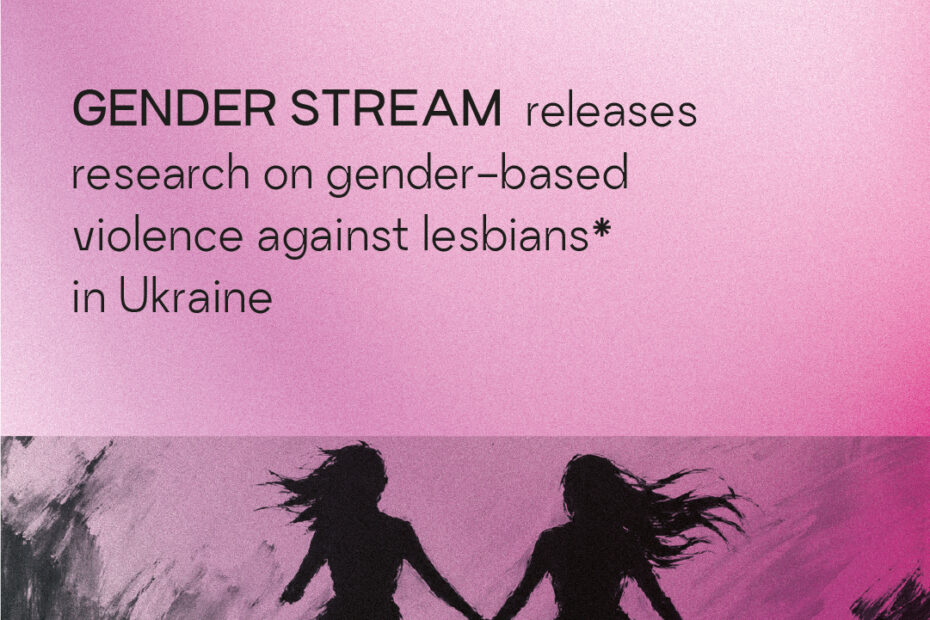
What forms of violence do LGBT* women face in Ukraine? How has the full-scale war affected their safety, access to support, and sense of security? What systemic barriers force many to conceal their identities and discourage them from seeking help?
These are the questions explored in a new study by the civil society organization Gender Stream, dedicated to the experiences of LGBT* women in Ukraine.
The research is based on 21 in-depth interviews conducted between 17 January and 12 March 2026. Participants included lesbians, bisexual and queer women, as well as one person who was assigned female at birth and socialized as a woman before later undergoing a trans* transition. While the study is not statistically representative, it provides valuable qualitative insights into how war, structural invisibility, discrimination, and violence shape the everyday lives of LGBT* women.
Among the key findings:
- The full-scale war has intensified economic vulnerability, housing insecurity, and dependence on family members and partners.
- Many participants conceal their sexual orientation due to fear of discrimination and violence.
- LGBT* women experience multiple forms of violence, including psychological, economic, sexual, medical, and cyber violence, as well as violence within families, schools, workplaces, and intimate relationships.
- A significant proportion of respondents do not report incidents of violence to the police due to distrust of law enforcement, fear of being outed, and concerns about secondary victimization.
- Younger participants are more likely to associate their future with emigration because of the war, insufficient legal protection, and the inability to live openly in Ukraine.
- The lack of legal recognition of same-sex partnerships significantly restricts access to fundamental rights and increases vulnerability during times of crisis.
The study also highlights the urgent need for legislative reform. In particular, it calls for strengthening legal protection against crimes and offences motivated by bias and intolerance, as well as adopting legislative changes that would ensure effective protection from discrimination and violence, including Draft Law No. 13597. Equally important is the legal recognition of same-sex partnerships as a mechanism for ensuring social, economic, and security-related protection.
The research further provides recommendations on expanding access to psychological, legal, and crisis support services for LGBT* women; strengthening training for law enforcement officers, healthcare professionals, and social workers on non-discriminatory practices; supporting civil society organizations; and developing effective mechanisms for responding to violence.
The experiences of LGBT* women remain largely invisible in public policy and public discourse. In the context of the ongoing war, this invisibility has become even more pronounced. This research therefore represents an important step toward developing safer, more inclusive, and more equitable approaches to human rights, gender equality, and the prevention of violence.
The project is implemented with the support of the EuroCentralAsian Lesbian* Community and the European Union. Its contents are the sole responsibility of Gender Stream and do not necessarily reflect the views of the ELC or the European Union.*